
*soccer* is romantic
collective effervescence and the World Cup

I feel like whenever I write about sports, I need to preface with the fact that I am no expert, nor will I ever be. It’s funny, because I’m not an expert on government, religion, or sexual politics either, but nobody questions me on that. Each time I comment on sports, I get a wave of backlash from former frat bros telling me to shut up and women saying I’ve been red-pilled. C’est la vie.
But until recently, I’ve never really been a “sports person”. Sure, I grew up cheering for the Warriors and I ran the bases at Oracle Park when it was still AT&T Park. And I went to soccer games. More than I can count. I used to view soccer as something my sister was fantastic at and I was abysmal at. Now, I view soccer — like all sports — as a connection point. And in the past two weeks, I can’t help but become emotional watching the World Cup.
This isn’t just because my teams are winning or losing. Last week, Andrew and I told our waiter that we were going to watch the Mexico vs. South Korea match and he asked what teams we’re cheering for. Saying the USA would’ve been an easy answer, but in reality I’m cheering for everyone. I love watching teams from tiny countries make their debut and upset giants. I get emotional watching entire cities transformed by the World Cup. Locals embracing teams from countries they’ve never heard of before, strangers singing together in bars, people draping themselves in flags and believing that they belong to something bigger than themselves. Even if it’s only for ninety minutes.
This is the utopia I was promised as a child, and there’s a term for this feeling. Collective effervescence. Coined by sociologist Emile Durkheim, it’s the intense sense of unity, energy, and community that occurs when people gather together for a shared purpose or ritual. Historically, these rituals have been religious festivals, holidays, concerts, and even winning battles. Humans are social creatures who need community, and the World Cup is one of the last truly global rituals. Maybe I romanticize pedestrian life too much, but this has made a sport seem like something truly magical to me.
You can see collective effervescence everywhere in the World Cup. Every host city seems to undergo the same transformation. Lawrence, Kansas, has fully embraced the Algerian national team. They were welcomed by a high school band playing their national anthem, flags draped from windows, and a new group of die-hard fans. The locals have drawn similarities between the city of Lawrence’s history of rebellion during the Civil War (hello Bleeding Kansas) and Algeria’s fight for freedom from France in the 1960s. South Korean fans have become brothers with Mexican locals and are seen singing and taking shots of tequila together before games, even when they were playing each other. A Japanese TikToker, Bob from Japan, has documented the kindness of strangers and his introduction to the best of American culture — Texas barbecue, BuzzBalls, and Buccees. And how can I forget Scotland’s Tartan Army and their invasion of Boston. They stood for all nine innings at a Red Sox game, drank all the beer in the city, and earned Glasgow a designation from Boston’s mayor as a sister city. For a month, social boundaries are temporarily dissolved and we connect despite lack of common tongue. We are reminded of how quickly community can form when we have something to share.


That’s why I think sports are romantic. They invite us to gather together and hope against impossible odds. We are encouraged to cheer for the underdog, and watching their success feels profoundly moving. Curaçao, a tiny constituent of the Netherlands, made their World Cup debut against Germany. Even though they lost 7-1, the world cheered with them because they scored a goal and cried with them when their anthem was played for the first time. Every game contains stories of heartbreak and miracles. Lionel Messi scored his first ever World Cup hat trick and reminded us that at 39, he’s still got it. I remember being on a choir trip in Buenos Aires during the 2014 World Cup and cheering with locals in a tiny restaurant when he scored then. Sports remind us that superheroes exist and that David and Goliath stories can be true.
The 48 national teams that are participating this year carry far more than the eleven players on the field. In the United States, we cheer for local teams. The MLB, NFL, and NBA ask you to support a city or sometimes a particular athlete. International teams ask you who you are. Despite the critiques of Americans holding nationalistic views, the United States is home to members of every global diaspora. The Cape Verde team was shocked to be welcomed by so many countrymen in the Northeast, which has one of the largest Cape Verdean populations outside of Africa. These national teams represent memory, language, and home. Watching people who left their home countries for opportunities in the Americas singing their national anthems is incredibly powerful. Knowing the history of some of these teams is even more so.
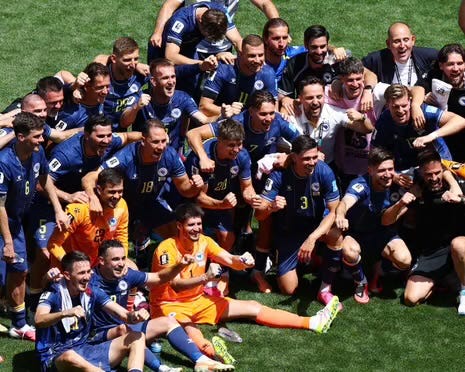
Bosnia and Herzegovina is a small country in eastern Europe that was part of former Yugoslavia. They were welcomed to St. Louis, Missouri, which is home to nearly 70,000 people of Bosnian descent. This year, their team has qualified for the knockout round for the first time ever. Many Bosnians fled to the United States in the early 90s during a period of intense political unrest and genocide that left 200,000 dead and 2,000,000 displaced. Several of the players were born during the Bosnian War and had family that were killed. Now, their appearance on an international stage is a symbol of resistance, survival, and triumph. It is proof that they exist, that they’re here, and that a country whose existence was fought so hard for persists. In a way, the World Cup gives countries that rarely dominate world headlines a chance to be seen and celebrated. This is why I will cheer for the Bosnian team, even when they play the United States in the upcoming round.
As an American, I am fed so many headlines and news stories documenting the horrors our administration inflicts on citizens and the world alike. So many to the point that I forget why I was once proud to be an American. Modern media rewards outrage, conflict, and polarization. Though privileged, it’s easy to feel alone as an American — like we’ve been cut off from our global community. A cage of gilded gold is still a cage nonetheless. It’s easy to believe that humanity is becoming more fragmented by the day. Camaraderie on a global level is something that we are lacking for. I speak for myself and other Americans when I say the World Cup has been healing. We aren’t bad, we’re just under bad management. Seeing people gather across nationality, race, religion, and language is a reminder that we’re not alone. Watching visitors experience American innovation, Southern hospitality, and a culture of kindness and curiosity is a welcome contrast to what we hear about ourselves. Conflict doesn’t fully disappear, but community proves possible. On a micro level, this World Cup has encouraged me to wish people good luck when I see they’re wearing a team’s jersey and high-five people in restaurants after goals. Our shared joy is an act of resistance against forces who benefit when we hate each other.
I don’t think what I’ve fallen in love with is soccer. I think I’ve fallen in love with what sports can reveal about people. Collective effervescence isn’t about penalty kicks or headers. It’s more about belonging and participating in something that is bigger than you. It’s about being open to learning, welcoming, and embracing ideas and people who you wouldn’t typically encounter. As an American, this offers hope amidst a relentless and vicious news cycle. When I zoom out from the joy of seeing the German team singing country music or watching international fans learn about free refills, I am left with the image of a globe. And I see it not as a collection of independent nations, but as a global community. In the modern day, things feel pretty bleak most of the time. But the World Cup gives us a glimpse of what we could have. That’s the greatest gift of this tournament. The reminder that we were never meant to cheer alone.